AI-First.
What we learned at Roamler.
A practical story — and a working approach for your early-warning risk dashboard.
Two hours, two halves.
Our AI journey
- Who we are, in two minutes
- Two years, two distinct eras of AI
- Our framework: People · Process · Product
- Concrete examples and the four bets we're placing now
- Hard-won lessons & anti-patterns
Early-warning risk dashboard
- What we heard from you
- The two kinds of risk to monitor
- A four-track approach
- A three-week MVP plan
- How to start tomorrow morning
The Roamler journey.
Not a strategy deck. A field report — what worked, what didn't, what surprised us.
Roamler in two minutes.
- A platform-based scale-up, 15 years old, HQ Amsterdam.
- A crowd of "Roamlers" across Europe collects on-shelf retail data and does small in-store tasks.
- Alongside that, a database of ~3 million out-of-home locations — restaurants, cafés, hotels — used for smart sales routing.
- Customers include Unilever, Procter & Gamble, Nestlé and other large FMCG brands.
What we do, in one line
We help our customers understand and act on what's happening in the field — on shelves and in outlets — at scale.
Why this matters today
We sit on millions of pictures, receipts, and outlet records. AI changes what we can do with that.
For us at Roamler, AI has had two distinct eras.
AI as a sophisticated chatbot.
You type. You get an answer — sometimes a document, a plan, an image. Genuinely useful. Term-based: I put something in, I get something out.
For most of us at Roamler, this is what AI meant for two years.
Agentic AI. AI does the work; you help it succeed.
You give a goal. The AI plans, takes actions, calls tools, browses, drafts and corrects. The role flips entirely.
Also: the integrations matured. Claude in Excel, Chrome, PowerPoint, terminals. Suddenly real.
If your AI thinking is still from Era 1, you're solving last year's problem.
People · Process · Product.
Three stages of becoming AI-first. Our experience: building them roughly in this order has been the strongest path for Roamler.
People
Give everyone the tools. AI as personal cruise-control. The foundation: if people don't have it, the next two stages don't really land.
Process
AI runs the process. Human becomes the human-in-the-loop, not the other way around. Real automation, with judgement.
Product
AI shows up in what you sell. For us: customers can use their AI to interact with ours. New propositions become possible.
Bring everyone along. Twice.
We started with Open Web UI — an open-source chat front-end, multiple model providers, our own knowledge added. We called it co-pilot.roamler and made sure everyone in the company got the introduction.
When the agentic shift happened in January 2026, we did a second pass through the whole company — this time introducing Claude on an enterprise licence, with data residency taken care of.
- Multiple locations across Europe — we made sure nobody was skipped.
- No "AI champions only" — everyone in.
- People with drive pick it up fast. You can't predict who.
Why two rounds: the tool we deployed in Era 1 was not the tool that mattered in Era 2. Each shift deserved its own conversation.
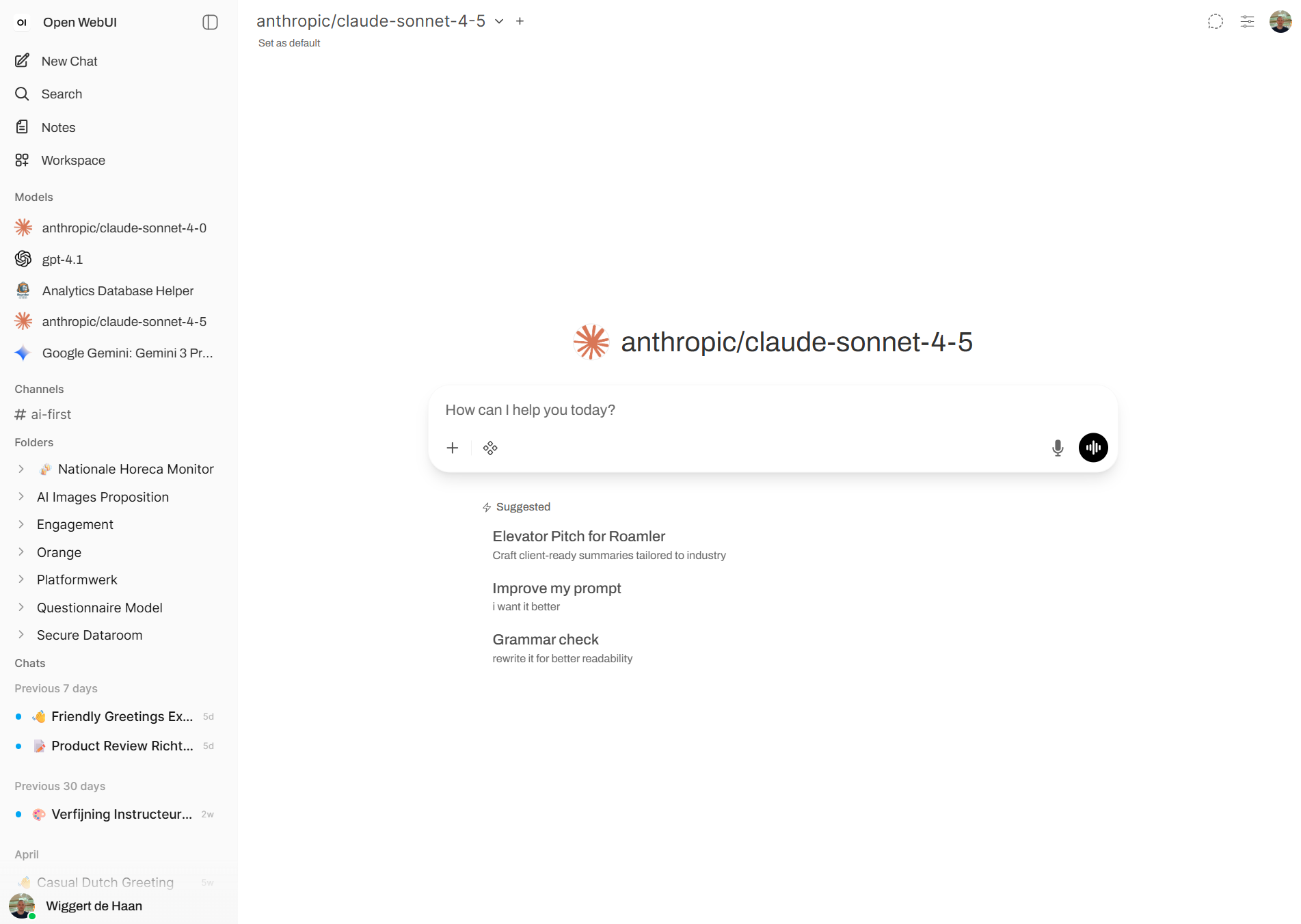
co-pilot.roamler — where it all started for our team.
Be honest about the efficiency story.
We do this to become more efficient. That's the point. Pretending otherwise is patronising.
Concrete: our HR team is three people for ~100 FTE. We've told them openly — "Wouldn't it be amazing if you could run this with two?"
Same for almost every role. Over time, some people will move on. When they do, they'll be far more valuable than if we'd hidden the change from them.
Give people the tools, be honest about what's changing, and you maximise their options — not just yours.
10 Golden Rules. Required reading for every Roamler.
When you give everyone AI, you have to be explicit. We wrote down ten rules and ask every employee to read them. A few of the most important:
- Keep passwords and keys away from the AI. Some tools silently read configuration files in your project folder.
- Don't paste customer or personal data. Everything goes to external servers.
- Don't understand the prompt? Say no. Saying no breaks nothing. Saying yes to something you don't understand has caused real damage at other companies.
- The AI will sound certain even when it's wrong. Verify what matters before you act on it.
- Review everything that goes live. Internal drafts: fine. Anything that reaches a client, production, a decision: human review first.
AI is a power tool, not a colleague. The operator is always responsible.
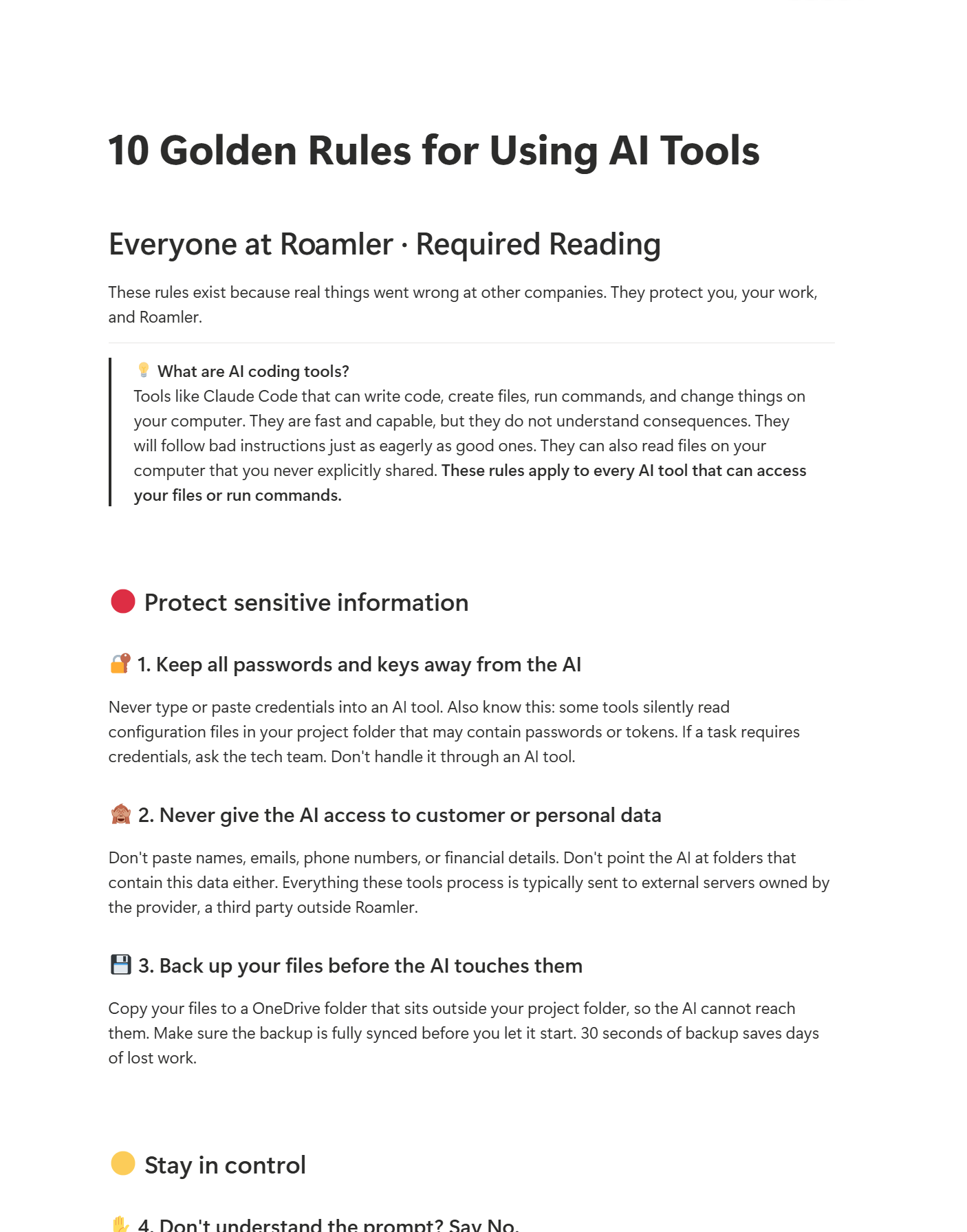
Roamler's 10 Golden Rules — published, signed off, on every onboarding checklist.
I built myself a CEO.
I run an agentic framework on my own machine. I talk to "my CEO". It manages several entities — Roamler-adjacent, a side project, my local sailing club.
This year's full sailing-season administration — classes, registrations, communications — happened almost entirely autonomously, after one setup.
The pattern that matters
- Set up once, run forever.
- One conversation → many delegated agents.
- Information compounds: the more context you feed it, the richer and more reliable the output becomes.
If I can do this for a volunteer sailing club, your Investment Managers can do it for partner monitoring.
One hour. From idea to running tool.
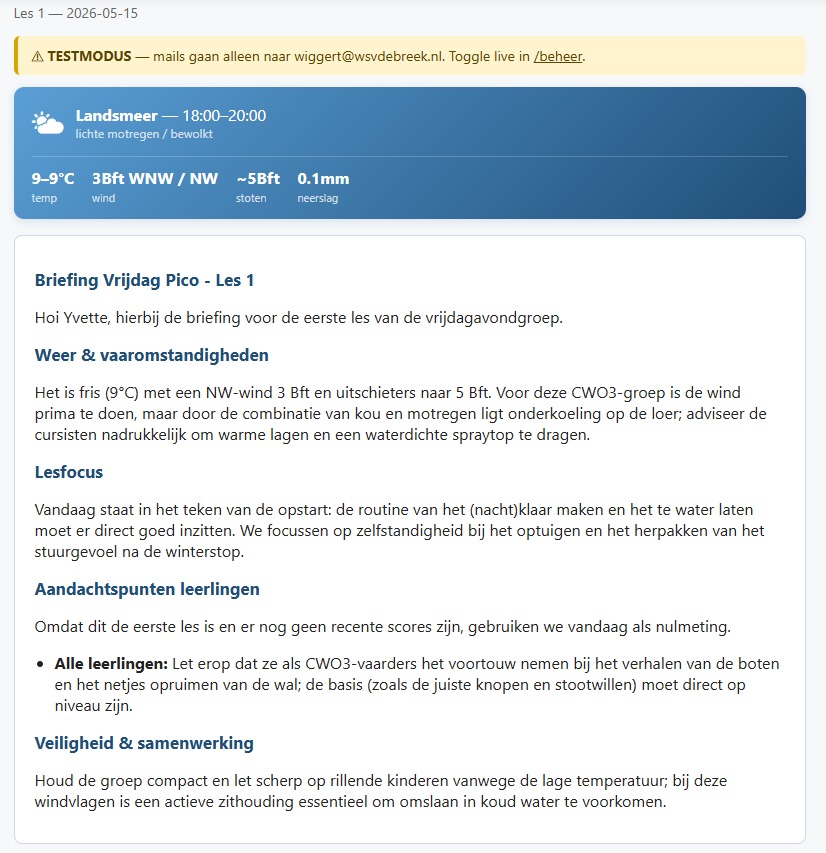
Last weekend I vibe-coded a small tool for my sailing school — WSV De Breek.
- Per-lesson weather forecast: location, wind, temperature, rain.
- Per-group briefing: focus, attention points, safety notes.
- Tailored to the lesson plan, the group, the conditions of the day.
Total build time: 60 minutes.
A year ago this would have been a project. Now it's a Saturday afternoon — built by someone with no spare time and no graphic designer.
AI takes over the process. Human becomes the loop.
Once people have mastered Stage 1 — when AI is second nature — they start automating their own work. The question shifts.
Old question: "How can AI help me do this task?"
New question: "What's left for me to do at all?"
The role flips. Human in the loop, not human in the driver's seat.
Two real examples next — both running in production at Roamler today.
Reviewing submissions, automatically.
40 to 50 reviewers, day-in day-out, approve or reject what Roamlers send in. Approve → Roamler gets paid. Reject → they redo it.
Manual, repetitive, slow. Perfect target.
So we set out to automate it — and we did not pick one approach. We are running four in parallel.
Rule-based AI
Use the task's questionnaire as context, generate decision rules.
Learn from humans
Train on years of reviewer decisions.
n8n workflow
Glue + LLM steps. We may drop this — and that's fine.
CrewAI feedback loop
Multiple agents iterate on each other's judgements.
Some of these will fail. That is the point. Only one needs to win.
2,000 receipts a week from Action stores.
Roamlers photograph receipts. Two thousand a week tells us what the Netherlands buys at Action.
Rules are simple. AI applies them autonomously:
- Receipt number must be unique.
- Country must be NL, FR or BE.
- Date must be in this week's window.
- Image must be readable.
AI approves. Roamler gets paid. Edge cases → human review. Appeal → human review.
Why this is safe
- The decisions are bounded — narrow rule set, small payments.
- Each decision is logged with the reasoning trace.
- If someone games it, we learn and harden.
- People can always appeal to a human.
Autonomy needs boundaries and an audit trail. That's it.
AI in your offering. Not just behind it.
When we put AI into our products, our customers' AI can talk to ours. That's a new conversation — and a new market.
The shelf-meter model.
For 10 years we collected shelf photos and shipped them to a specialist for image recognition. They counted facings, share-of-shelf, planogram compliance.
Last year I tried something. I trained a model — myself — that measures the metre marks on a shelf to anchor facing counts.
- 500 example photos.
- I corrected the AI where it guessed wrong.
- Iterated until accuracy was good enough.
A year earlier this would have been weeks of expert work. Now it's a Tuesday afternoon.
We pitched Unilever directly — without our 10-year image-recognition supplier.
We can do what they did. AI shrunk the moat.
The rule
If you can climb up the value chain, do it now. Because if you don't, someone else will climb past you.
One north star.
Three bets that get us there. Plus an enabler.
Everyone improves their own work — encouraged. But as management, we're explicitly investing in one direction and the bets that feed into it.
Next Best Action.
We move from "we collect data and execute tasks" to "we predict — and execute — the right next action" for our customers in every store and outlet.
Perfect Flow
Every step of the customer + Roamler journey, automated. Knowledge captured in the org, not in heads. Human only where humans matter.
Image Recognition
Move up the value chain — take over what specialist partners used to do. The intelligence we need to recommend the next action.
Smart Outlet Routing
3M outlets across Europe, AI-enriched. Send field sales reps to the outlets most likely to convert — the next action made smarter.
An internal deployment platform.
Anyone who builds with Cloud Code can publish a dashboard or agent safely, without depending on IT. The risk of not doing this is bigger than the risk of doing it.
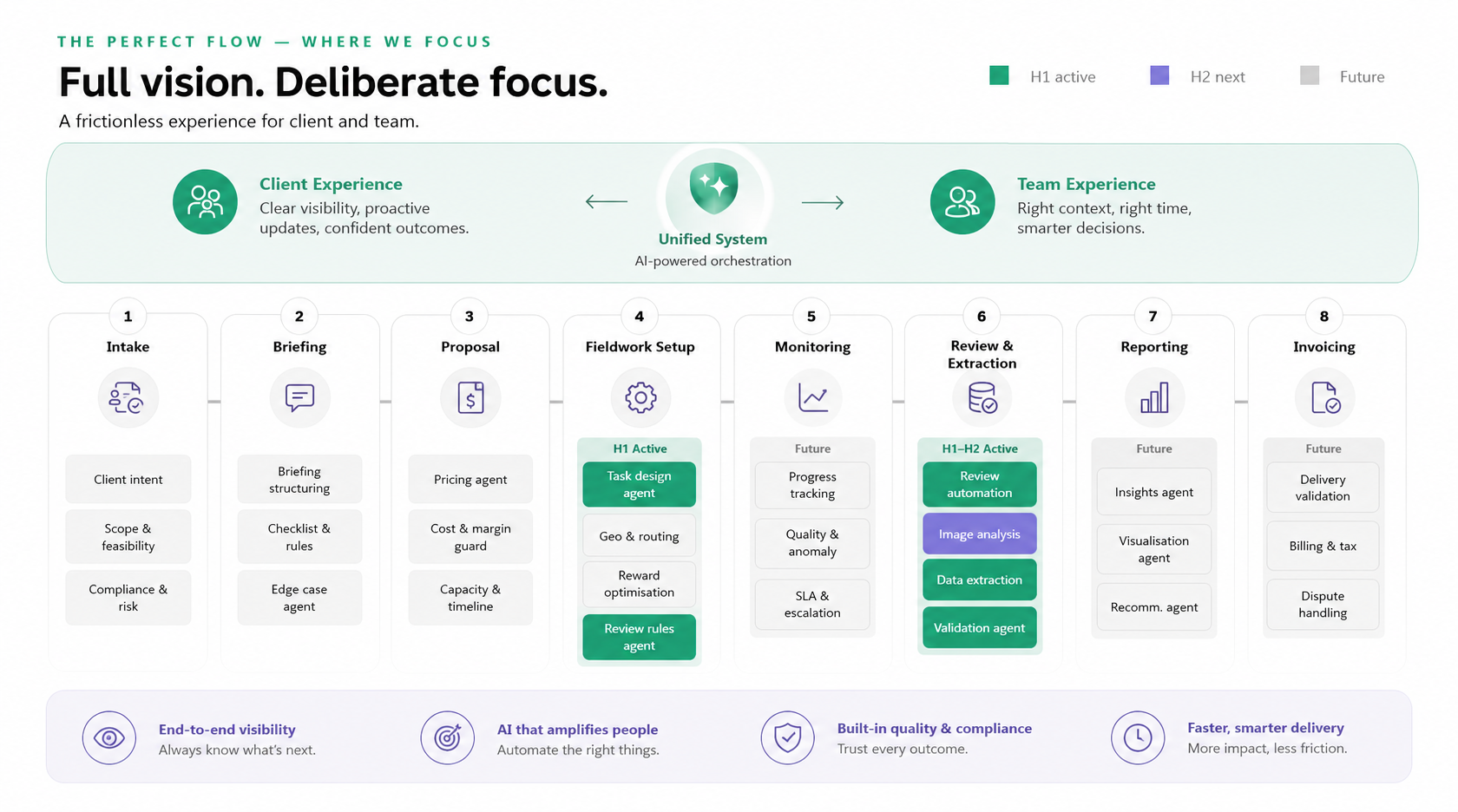
One unified flow. Eight stages. AI woven through.
The picture we're working towards: a frictionless experience for both client and team, from intake to invoicing.
- Eight stages — each gets its own AI agents. Some live today (green), others on the roadmap (purple).
- Two parallel pillars: client experience and team experience. Same data, two audiences.
- A unified-system orchestrator ties it all together — not five disconnected automation projects.
This is the diagram we walk every Roamler through. It's how everyone keeps the bigger picture in mind while building their piece.
What we learned
the hard way.
None of these are about models. All of them are about people, pace, and money.
Speed beats perfection.
Build the 3-week MVP, not the 9-month dream.
Try four approaches at once. Most will fail. The cost of trying is near zero. The cost of not trying is that a competitor — or your own back-office — gets there first.
In hindsight at Roamler: we were too slow adapting our roadmap to the new cadence. The technology was moving in weeks; we were still planning in quarters.
- If you're scoping a project longer than a month, you're scoping the wrong project.
- "What can we have running by Friday?" is the right opening question.
- Done > planned. Always.
The bottleneck is human, not technology.
Last month we automated a Roamler messaging flow. I showed the team Claude Code + Playwright. They saw it. They liked it.
Their reply: "Let's discuss this at our offsite on May 28."
The AI is already doing the work. The humans are scheduling a meeting about whether to start.
Most delays cost more than the implementation does.
- Getting people together to talk about progress: valuable.
- Waiting for that meeting before starting: costly.
- Replace status meetings with running prototypes whenever you can.
Your AI lead is an enabler, not a builder.
If your AI lead builds everything, they become the bottleneck — and the org never develops the muscle.
The job is to:
- Build the first showcase, then step back.
- Train others. Pair, mentor, unblock.
- Curate tools, set guardrails, govern.
- Evangelise — internally, relentlessly.
If you build, you become responsible. If you enable, the organisation becomes responsible.
Lesson learned twice
Give everyone the tools.
Today. Not next quarter.
This is the People pillar in practice. It is — bluntly — immoral to withhold this technology from your colleagues. They see what's possible. They want to do better work. Help them.
And: if you don't give people enterprise tools, they will use their personal accounts. That is your real data risk.
What we do at Roamler
- Enterprise Claude for everyone — ~€20/person/month.
- If someone burns through it, we top them up.
- Power users get the Max plan (~€200/month). No-brainer.
Compare €200/month per person to even one day of a consultant. The math isn't close.
Shadow-IT is already happening. Look closer.
If you don't give people enterprise AI tools, they will use their own — personal ChatGPT, personal Claude, free tiers, browser extensions.
And they won't tell you, because they're afraid the answer will be no.
- Customer data ends up on consumer accounts.
- Prompts (and your IP) feed model training.
- No audit trail. No DPA. No accountability.
- You only find out when something leaks.
The choice isn't AI or no AI. It's sanctioned AI, or shadow AI.
Our experience at Roamler: the moment we rolled out enterprise Claude broadly, the personal-account question went away. Not because we banned anything — because the official tools became better than the unofficial ones.
Lesson: out-compete shadow IT. Don't try to police it.
Whitelist two or three providers.
Anthropic. OpenAI. Microsoft. Google. Pick two or three. Get them all approved.
- One of them will fall behind for six months. You want to switch.
- One of them will raise prices aggressively. You want to switch.
- One of them will have an outage. You want to switch.
This is why we started with Open Web UI — one chat interface, swap the model behind it as the landscape changes.
Single-vendor lock-in is the largest avoidable AI risk you have.
Today Anthropic is subsidising heavily. That cannot last forever. Plan accordingly.
Watch the tokens.
Honest: this is something I do privately, not yet enough at Roamler scale. But it's on my list.
I have a personal agent that emails me a daily token-burn report. One recent 24-hour burst: $500 of tokens on a heavy job. Subsidised today. Not forever.
- Cheap models for noise-to-signal triage.
- Mid-tier models for routine reasoning.
- Top-tier models only when judgment really matters.
Match the model to the task. Treat tokens like cloud bills — not like Wi-Fi.
Today it's a curiosity. Within a year, it'll be a line item the CFO asks about.
Diverge first, then converge.
When we gave Claude Code to everyone, different people solved similar problems in wildly different ways.
That feels chaotic. It is also where the insight lives.
- Let people build their own version.
- Then pull them into a room, show each other, merge the best.
- Don't standardise too early — you'll standardise on yesterday's idea.
Differences in solutions reveal differences in how people actually work. That's the gold.
For stable workloads, prefer code over tokens.
Have AI write the code once. Then run that code forever — zero tokens.
Use LLMs only where you actually need judgement.
- Dashboards, ETL, calculations → code.
- Triage, classification, judgment, synthesis → LLM.
The architecture
AI builds the system. The system runs cheap.
AI sits on top, where it actually adds value.
This is also the answer to "what about compliance / data residency / cost?" — keep tokens where they earn their keep.
Audit trails are non-negotiable.
Every prompt. Every input. Every output. Every decision. Every escalation. Logged, traceable, queryable.
- Moral: people deserve to understand why a decision was made.
- Practical: regulation is coming (AI Act, DORA, sector rules).
- Operational: you cannot debug what you cannot replay.
For Oikocredit this is doubly true: the trail of a partner decision is part of your impact story.
Transcribe everything.
But know what you're doing.
Every meeting. Every customer call. Every field visit. AI loves unstructured text. The corpus compounds. The more data you have, the stronger the system becomes.
For your Investment Managers visiting partners on the ground — these notes are gold. Tomorrow's risk signal is hidden in last quarter's site-visit transcripts.
There are real risks here too.
- People may stop saying things they'd otherwise say.
- Sensitive context can leak across audiences if data policy is weak.
- We're still working through this at Roamler — sales coaching first, with consent.
The bigger lesson: get your data policy right before you scale the corpus. The win is real, but only if the foundation is solid.
Don't let compliance block experimentation.
Start with non-sensitive data:
- Internal procedures & policies.
- Public market data.
- Anonymised samples.
Build the muscle. Then expand into sensitive data with proper enterprise contracts in place.
The 80 policies, in a day
You have ~80 internal policies. Finding the gaps and overlaps used to be a multi-month project. With Claude Code on a pilot account, that's a one-day exercise.
No personal data. No external transfer risk. Massive win.
"Our data isn't clean enough" is a stalling tactic.
It usually isn't. Yours included. That is normal.
Build something with what you have. The first model will tell you which data actually matters. Then upgrade the sensors that matter.
The cleanest data plan is the one you discover after building the first version.
What I'd do differently.
If I'm honest about our own journey, the two biggest regrets are both about speed.
We didn't go fast enough.
We waited too long on too many things — clarity, governance, the perfect tool. Almost every time, just starting would have been the right call.
We didn't bring people along fast enough.
The People stage takes longer than you think. We could have started the org-wide rollout earlier, with less polish. The people who eventually thrived would have thrived sooner.
We dismissed tools too early.
A tool that doesn't work well today often works fine in three months. Claude Code went from "interesting" to "essential" in one quarter. Image generators kept getting better while we'd already stopped trying.
Speed in adoption beats elegance in design. And give the rejected tools a second look every quarter.
Build bottom-up: People → Process → Product. Move fast, ship MVPs, give everyone the tools, watch the tokens, audit everything.
Now — your case.
A regional director gets an alert: "Partner X in Ghana — 4 signals triggered this week. Two materialised, two predictive."
They click. They see the chain of evidence. They call the Investment Manager. The Investment Manager is on the ground in 48 hours.
That conversation used to start three months later, after the quarterly report.
Three weeks from now, that can be real. Here's how.
The starting position is strong.
- ~500 partners across ~30 countries. Mostly MFIs (70%), plus agriculture (20%) and renewables (10%).
- Average partner ≈ 15 years with Oikocredit. About 3 repeat loans on average. You know them.
- Excellent risk-prevention practice: local-law contracts, ~90% collateralised, strong collection rate.
- 15 years of partner data already exists — payments, restructurings, ESG scorecards, site-visit notes.
- The indicator framework is already there — PAR++, CRS, financial ratios, financial gaps, governance, macro. Solid work.
- Data sits in Salesforce, Excel, and external feeds — not yet integrated per partner, not real-time.
- Monitoring today is quarterly. By the time a signal shows up, you're often already late.
- A pilot is already running — a chatbot that lets the team feed in partner-specific context and combines it with external signals. Early, but it works. Now: scale and automate.
The risk dashboard is a Process play.
But with a Product upside.
Already moving.
Internal momentum is real. The next step is making sure every risk officer, Investment Manager and regional director has enterprise-grade tools and time to use them.
The risk dashboard.
Integrate the data. Automate the monitoring. Surface the alert. Free your Investment Managers from manual triage; let them focus on the partner conversation.
What you offer next.
Could partners themselves benefit from your early-warning intelligence? A premium service? An impact differentiator? Worth a separate conversation.
There are two kinds of risk in your portfolio.
It already happened.
- PAR30 / PAR60 / PAR90 breaches
- Missed payments
- Restructurings, write-offs
- Covenant breaches
You have the data. You have indicators. You don't have the integrated view. This is an integration problem.
It's going to happen — but hasn't yet.
- FX freeze in Ghana, announced tomorrow
- Coup in Mali
- Board fraud surfacing in local press
- A central-bank rule about to change
Moody's tells you too late. Local news, fora and parliament feeds know first. This is a sensing problem.
A real early-warning dashboard solves both.
One dashboard. Per partner. Real-time.
Internal signals
- Payments & PAR
- Financial ratios (CAR, OSS, EAR, LAR, debt/equity)
- CRS score & sub-components
- ESG scorecard
- Investment Manager site-visit notes & e-mails
- Covenant breaches, restructurings
External signals
- Country ratings (Moody's, S&P) — as baseline
- FX, inflation, interest rates
- Local news per country
- Political & parliamentary streams
- Sector forums & social signals
- Regulator announcements
→ Per partner, per region, per portfolio. Alerts to the right human, at the right moment.
Four tracks. Each strengthens the analysis.
Run them in parallel. They reinforce each other: better indicators feed a better dashboard, external signals enrich the partner view, the predictive layer ties it all together.
Sharpen the indicator set
Feed the existing framework + 15 years of history to AI. Ask what predicts default best. Validate with the risk team.
Output: empirically weighted indicator list.
Build the integrated dashboard
KRI traffic lights + scatter diagrams in the existing visual language, per partner, region, portfolio. Direct from the data warehouse.
Output: living dashboard, not a quarterly PDF.
External signal agents
~30 country-specific agents crawling news, parliament, fora. Cheap LLM filters noise; smart LLM synthesises.
Output: daily country/partner signals.
Predictive model
ML on 15 years of partner history + macro + visit notes. Predicts default probability and drivers.
Output: partner-level forward score.
Some tracks will mature faster than others. All four feed the same partner view in the end.
Sharpen the indicator set.
The strategic work is already done — a solid framework exists:
- PAR++ (PAR30 + restructured + write-offs)
- CRS & sub-scores
- Financial ratios: CAR, OSS, EAR, LAR
- Financial gaps: liquidity, FX, IRR
- Concentration: borrowers, depositors, Lorenz/Gini
- Governance & macro (qualitative, background)
Now feed this and 15 years of actual data to AI.
Ask:
- Which indicators correlate best with actual defaults — by region, by partner type?
- Are there leading indicators we didn't consider?
- Which thresholds are empirically right, not "what felt right"?
Risk team validates the candidates. The existing framework gets quantified, not replaced.
Build the integrated dashboard.
Direct from your data warehouse. Not Excel. Not quarterly.
- Per partner view — every indicator, traffic-light status.
- Per region / per country roll-ups.
- PAR / growth scatter (the existing quadrant view — partners coloured by CRS).
- Concentration views: top borrower share, Lorenz/Gini, covenant breaches.
- Alerts pushed to regional directors and Investment Managers when thresholds breach.
How fast, really?
Claude Code + your data warehouse + the existing indicator spec. Working prototype in days. Production-quality MVP in three weeks.
Yes — also run the planned Excel version in parallel. They reinforce each other. The Excel version is your fallback and your validator.
What a partner row looks like.
| Indicator | Watch | Limit | Q2 '25 | Q3 '25 | Q4 '25 | Q1 '26 | Status |
|---|---|---|---|---|---|---|---|
| PAR30++ | ≥5% | ≥10% | 9% | 12% | 9% | 4.5% | Green |
| Missed payments (12m) | ≥10 | ≥20 | 9 | 12 | 15 | 23 | Red |
| Covenant breaches | ≥20 | ≥50 | 11 | 17 | 15 | 25 | Amber |
| Write-offs | ≥0.5% | ≥1% | 0.7% | 0.8% | 5% | 1% | Red |
| OSS < 105% | 20 | 30 | 18 | 23 | 25 | 44 | Red |
| FX gap | ≥15% | ≥20% | 12% | 13% | 13% | 15% | Amber |
Plus an External signals column (Track 3): "3 amber signals from Ghana news this week." Plus a Predicted column (Track 4): probability of default in 90 days. That is the dashboard.
External signal agents.
Per country, a continuous agent that crawls:
- Local newspapers (in local language, translated)
- Parliament & regulator feeds
- Industry fora and social channels
- Central bank announcements
- FX, inflation, commodity prices
Two-layer architecture
- Layer 1: cheap LLM filters noise → candidate signals.
- Layer 2: smarter LLM synthesises & ties candidates to specific partners / sectors.
- Layer 3: dashboard surfaces top signals per partner with a confidence score and a citation.
Note: this is exactly what you proved with the Ghana agri experiment. Now: scale across 30 countries.
The predictive model.
15 years of partner history is a serious training set.
- Inputs: payment history, financials, CRS, ESG, covenant events, restructuring history, Investment Manager site-visit notes (transcribed), macro context.
- Target: did this partner default / restructure / write-off within N months?
- Output: partner-level default probability + the top drivers behind the score.
"What was the early signal we missed?" is now a query, not a post-mortem.
Start with a small validated set. Backtest against known incidents. Iterate. The agricultural-partner pilot is your seed.
Architecture, simplified.
Sources
- Salesforce (partners, deals)
- Excel risk reports
- Financial reports per MFI
- ESG scorecards
- Investment Manager notes / e-mails / visits (transcribed)
- External: Moody's, S&P, FX, news, fora
AI layer
- Unified partner data model
- Indicator engine
- External signal agents (per country)
- Predictive model
- Alerting rules & routing
- Audit trail of every decision
Users & outputs
- Per-partner live page
- Regional director portfolio view
- Risk committee dashboard
- Auto-alerts to Investment Manager & regional director on breach
- Quarterly board report (auto-drafted)
- "What did we miss?" backtests
Sources stay where they are. The AI layer reads from them; it doesn't replace them. This is incremental, not a migration project.
Three weeks to a working MVP.
Foundations
- Two licences approved & running
- Pilot country chosen (Ghana?)
- Indicators validated against 15-yr data
- Dashboard scaffold up
Real partners
- Connect data warehouse
- First 100 partners live
- External signals — pilot country
- Alerting rules drafted
Validate & iterate
- Backtest: would we have caught known incidents?
- Risk team reviews alerts
- Tighten thresholds
- Demo to managing board
Scale
- Roll out to all partners
- Add second country's signal agent
- Start predictive model (Track 4)
- Begin regional director training
Two people. One from risk. One from data. Three weeks blocked. That's the team.
Honest caveat: three weeks is realistic in technology terms. In organisation terms, it depends on how quickly the people involved can decide, review and respond. The code is rarely what slows this down — the humans around it usually are.
Don't let "compliance later" become "AI never".
- Start with non-sensitive sources: indicator framework, public macro, anonymised partner-codes.
- Spin up enterprise tier with DPAs in parallel — this is a four-week exercise, not a six-month one.
- Build the audit trail into the system from day one — not bolted on later.
- AI Act readiness: log inputs, outputs, models used, model version.
Risk boundaries to set explicitly
- What can the system recommend?
- What can it flag automatically?
- What can it act on autonomously (probably: nothing yet for portfolio decisions)?
- Who reviews — and how often?
Same logic as Roamler's receipt approval. Boundaries plus audit equals safe autonomy.
Five decisions — yours to take.
For the risk dashboard specifically. It's one important process — and there are dozens more behind it. But this is a strong place to start, with a clear outcome and a real audience.
- 1. Approve 2 enterprise licences for a strong agentic coding tool — Claude Code, Cursor, Codex, GitHub Copilot Workspace, any credible option. Roughly €400/month total. Not a budget item; a coffee budget.
- 2. Pick a two-person team — one risk, one data. Block 3 weeks of their calendar.
- 3. Pick the pilot country. Ghana, given the agri pilot already done, is an obvious candidate.
- 4. Decide one validation question: "Would this dashboard have caught the last three partner defaults?"
- 5. Block a 60-minute review with the managing board in three weeks. Hard date. Public commitment.
And in parallel — don't forget People. The risk dashboard is the tip of an iceberg. To get the rest, every Investment Manager, risk officer, regional director and back-office colleague needs the tools too. That's a separate decision — and an equally important one.
You don't need to be an AI expert.
You need to be willing to try.
The cost of trying is collapsing. The cost of not trying is being passed.
All that's left is to go.
Questions.
And what you'd actually like to build first.
Slides, code, and a starter repo available on request.